

Yang Amat Berhormat Perdana Menteri;
Distinguished KMF Speakers;
Board Members of Khazanah Nasional Berhad;
Distinguished guests;
Ladies and gentlemen,
Assalamualaikum Warahmatullahi Wabarakatuh and welcome to the Khazanah Megatrends Forum 2026.
INTRODUCTION TO KMF
1. Let me first record my appreciation to YAB Prime Minister Dato’ Sri Anwar Ibrahim for joining us here this morning at the Khazanah Megatrends Forum and for graciously agreeing to give the Opening Address. Sir, it is an honour.
2. Last year, we celebrated two decades of KMF, and I record my warmest appreciation to everyone who was part of that journey. This year, it is my pleasure to welcome you to the 21st instalment. Thank you for being here.
3. KMF has been a gathering of investors, business leaders, academics, policymakers, and community leaders – almost always on the first Monday and Tuesday of October every year (so do mark your calendars).
4. Nick, whose Research team curates KMF every year, once told me that the best compliment he has received is that KMF felt “like going back to university.” Perhaps, given how many academics we tend to have, but we do appreciate – and deliberately design – that KMF is not a typical business or investment conference.
5. This year, we introduced a mid-year KMF RE:CONNECT to extend our conversations beyond our flagship October sessions. I hope to see many of you at future RE:CONNECT sessions.
WHY “WHO’S GOT THE POWER?”
Ladies and gentlemen,
6. This year, our KMF theme is “Who’s Got the Power? Watching the Watchmen in an Imbalanced World”. And, as always, the theme comes with a theme song. <cue the music “Everybody wants to rule the world” taken from the end of the chorus and two bars after which is just instrumental> Hands up if you recognise it. I guess if you don’t, you’re perhaps too young! You will hear this theme song over the next couple of days… and this tune just may stick to your head forever!
7. Let me break down the overarching theme into 3 parts, and I will take them in turn.
8. First, “Who’s got the power?” Artificial intelligence is a contest over who owns the resources – whether chips, data, or data centres – and who captures the gains. Climate change is a contest over who dominates the rollout of green energy, and who bears the cost of the transition. And inequality is the scoreboard: it shows us who has been winning. But let us circle back to this question in a bit.
9. Second, “an imbalanced world”. Contests produce winners, and winners accumulate. This year alone, we have seen extravagant displays of executive power rippling across oceans and continents: the war in Iran and sweeping tariffs imposed by executive fiat, amongst others.
10. Third, “watching the watchmen”. The phrase comes from the Roman poet Juvenal, who asked nearly 2,000 years ago: who will guard the guards themselves? The watchmen are those we entrust with power on our behalf: governments, central banks, and, increasingly, commercial firms. But how do we hold them to account?
11. None of this is new. In the Concept Paper, we discussed the Panic of 1907, when depositors rushed to withdraw their funds and the US financial system nearly collapsed – with no Federal Reserve yet as the lender of last resort. At that moment, John Pierpont Morgan (JP Morgan as better known today) locked bankers in his home library, refusing to let them leave until they injected liquidity into the markets. One individual had effectively become the watchman over the financial system. But clearly a financial system cannot indefinitely depend on one individual.
12. To reduce that dependency and to infuse longevity, the Federal Reserve was created as a permanent, institutional lender of last resort. That transition – from the individual to the institution – captures a pattern history keeps repeating: power oscillating between the individual and the system. But notice that the question did not go away. It simply moved.
13. So perhaps what matters more is not who holds power, but what our checks and balances should be, regardless of who holds it. Whatever methods we choose must carry a deeper philosophy, which is the redistribution of power itself – those affected by power must also hold a share of it.
14. Put simply: the response to power concentration is agency – giving others the ability to act, to challenge, and to counterbalance it. Circling back to “Who’s got the power?”; at the end of the day, we all do. Where power constrains us, we must retain the agency to act. And where power resides with us, we must exercise it responsibly. That is the thread I ask you to hold on to over the next two days. I also strongly urge everyone to read the full Concept Paper on the KMF website.
KHAZANAH AND THE STEWARDSHIP OF POWER
Ladies and gentlemen,
15. In this KMF, we deliberately keep the definition of power broad, to interpret it across its many manifestations.
16. Khazanah is, first and foremost, an investment house, whose operations are unavoidably impacted by global megatrends. Many of these megatrends–inequality, climate change, shifting demographics, artificial intelligence – are, at their core, contests for power. In response, the world is pouring capital into 3 main sectors: energy, technology and security, each a smaller contest calling for its own counterbalance.
17. The first is the contest for energy. A single chokepoint, the Strait of Hormuz, has reminded us how much power rests with whoever controls a narrow stretch of water. The war in Iran has pushed up energy prices and inflationary pressure, prompting several central banks to hike rates – making capital more expensive and selective for investments.
18. The second is the contest for technology. Globally, from the US and Europe to Korea and Taiwan, indices hit record highs this year, fuelled by near-US$770 billion in AI capex bets, and profits concentrated among a few giants. For Malaysia, which hosts a growing share of this AI build-out, the question is whether we merely supply the land, water and electricity, or also hold a share of the power.
19. The third is the contest for security. From defence and food supply chains to human workforce, countries are paying a premium to depend less on one another. In this deglobalised world, whoever controls the critical inputs – through decade-long industrial policies, pure geographical luck (or even both) – holds enormous leverage.
20. Fundamentally, running through all three contests is the contest for capital. In this era of passive investment, power also rests with index providers. With a weightage of almost two-thirds of the MSCI All Country World Index, the US automatically attracts the bulk of passive flows, even if it contributes only about a quarter of global GDP.
21. But that rosiness in the financial markets has not necessarily translated to the real economy, especially in wealthier nations. Even as corporate profits and productivity climb, labour’s share of national income keeps slipping, and consumption itself has grown more concentrated among higher-income households: the so-called “K-shaped” economy.
22. And for all the capital poured into AI, a widely cited MIT study found that 95% of enterprise AI pilots have yet to show any measurable return. And as supply chain disruptions prolong, this makes us wonder: how long can this exuberance or “party” in financial markets last, all the more so when the party is loudest in a country whose debt has now hit more than USD40 trillion, or approximately 126% of GDP.
23. It is partly this fragility beneath a booming surface that is pushing countries to reach for resilience rather than pure returns. Big economies, like the US, Europe, China, can pull production and demand home, cushioned by vast domestic markets and deep public capital. But Malaysia has no such cushion.
24. So how does a small economy respond to these overpowering global forces? We all grew up with the stories of Sang Kancil, the mousedeer who crosses the river not because it is big but because it is clever. And legend has it that Sang Kancil inspired the founding of Melaka, a maritime sultanate that became great through trade and strategic location, not size. Malaysia has to be a Sang Kancil again: a clever, connected trading nation whose resilience comes from breadth – be it more sources of capital, export destinations, or supply-chain relationships.
25. For the past two years, one of our core messages at KMF was to be resilient like the steady Ant or the modest Potato. Resilience absorbs shocks. This year, I would go one step further: build agency to counterbalance the shocks, so no single source of power decides our fate.
26. While many manifestations of power are beyond our control, we still have the agency and must responsibly exercise the power vested in us as the sovereign fund of Malaysia. Khazanah, too, is a watchman. We hold capital in trust for Malaysians, and we, too, must be watched and be answerable.
27. So let me share how we are responding, starting with Khazanah’s own investment portfolio. You’ll hear more from Professor Redouanne Elkamhi and Jayne Bok, but in short, we are layering a Total Portfolio Approach, or TPA, onto our existing asset allocation. This cuts across asset-class labels, giving us a better view of the underlying exposures affecting our portfolio, rather than simply following where the market leads.
28. More broadly, given Khazanah’s mandate as a strategic investor in Malaysia, we’re also asking – what sort of economy becomes more able, more flexible, and just tougher, in the face of these global contests? One answer is an economy where power is not held by a few large firms alone. That is why we are programmatically building our mid-tier company layer. Though they represent only around 2% of all firms, mid-tier companies contribute around 40% of our country’s GDP and 16% of employment.
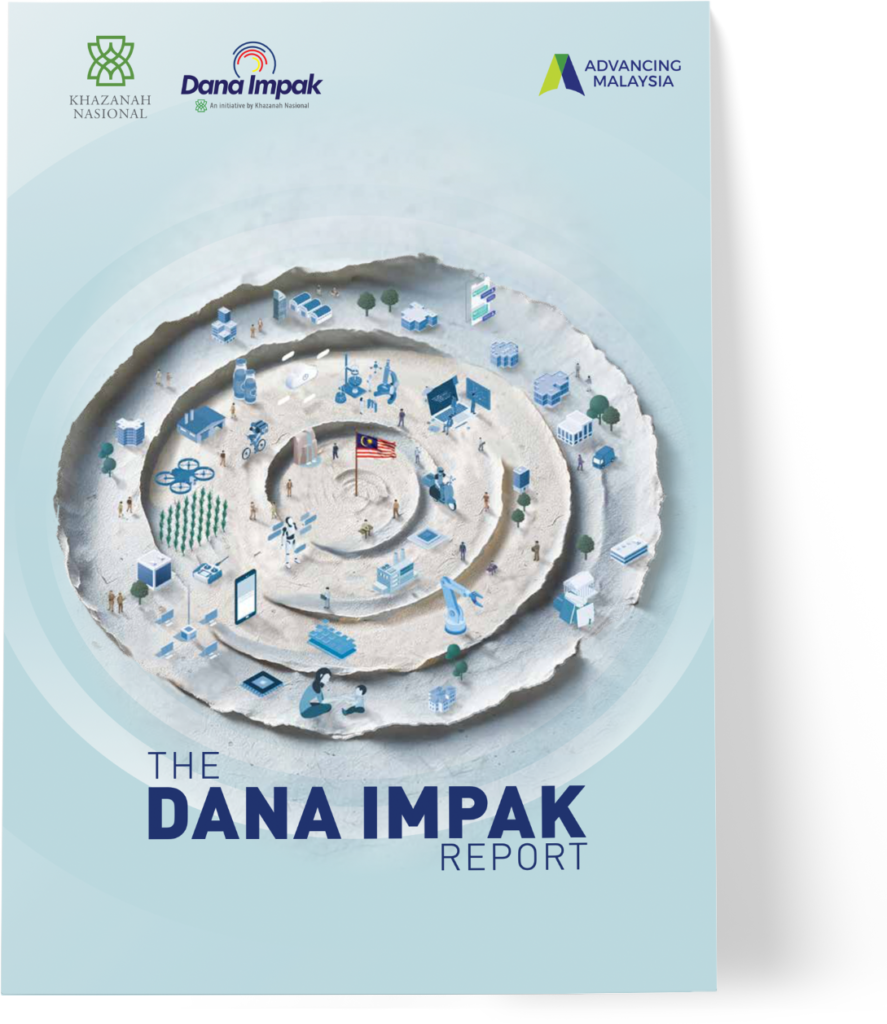
29. This is why, via our Dana Impak, we are helping to build a deeper bench of Malaysian firms that can stand on their own commercially, pay better wages, employ more people, and compete internationally – distributing economic power further across society. You’ll see this first-hand at our DI Mixer this evening, and we will also release our inaugural Dana Impak Impact Report at the end of this year’s KMF.
30. Let’s also not forget the power of connectivity. As raised earlier, a Sang Kancil nation must be well connected to the world. Through our Projek Warisan, we restored several historic buildings in the heart of Kuala Lumpur, including the recently opened Pejabat Pos Besar Lama. Heritage matters in its own right, but it also connects Malaysia to foreign visitors: giving them reasons to come, stay longer, and see Malaysia for themselves. For a trading nation, being a place the world wants to visit is itself a source of power. Please do pay our heritage buildings a visit when you can.
31. Finally, KMF itself manifests and distributes power, specifically, the power of knowledge. KMF began as a closed-door leadership retreat for Khazanah’s annual planning cycle. But the conversations proved far too valuable to keep within our walls, and so we opened the doors.
32. You have now seen why we keep our definition of power broad: energy, technology and security, capital and connectivity, and, in KMF itself, knowledge shared rather than kept. In each, the question and the answer are the same: where power concentrates, we claim our agency to power and wield it with stewardship.
THE KMF 2026 PROGRAMME
Ladies and gentlemen,
33. Now, I said earlier that Nick takes “like going back to university” as a compliment. Be warned: he and his Research team have taken it to heart, and have set you 2 full days of classes. The good news is: no exam, and better food than university.
34. Throughout this KMF, our core sessions will view the contest for power from four vantage points: how today’s geopolitical powers affect markets, how leaders wield institutional power to transform firms, what power structures look like from emerging economies, and, finally, how we regain power for communities.
35. We will open with a keynote by Professor Michele Gelfand, who will show us that even culture is a contest. Her framework of “tight” and “loose” cultures asks a question every organisation should sit with: is there a “correct” culture to strive towards? Her answer? Well, you will have to sit in to find out!
36. We also have several panel discussions and Ted-style talks – from the state’s role in resilience and tech-enabled productivity, to rethinking investment portfolios and economic development models. Each asks, in its own field, where power sits and how it can be balanced.
37. Our Innovation Without Borders session will showcase frontier ideas from AI industrial applications to biological computing. And there’s Malaysiana, always my personal favourite, where we dedicate the stage to extraordinary Malaysians driving inspiring change.
38. Let me thank, again, all our speakers for spending your precious time with us here in Kuala Lumpur. I have no doubt that everyone here is eager to hear what you have to share.
39. My hope is that, by the end of this Forum, we will see power in a new light: not simply as something others possess, but something each of us encounters and exercises in different ways.
40. The question, then, is what we choose to do with it. So, let us keep asking, with imagination and collective will – how do we exercise that power in our everlasting quest for a flourishing, inclusive, and sustainable future?
TO CONCLUDE
41. I wish everyone two days of lively, thought-provoking, and rewarding conversations at the 21st Khazanah Megatrends Forum. May what we hear and discuss here deepen our grasp of power, heighten our sense of duty in wielding it, and renew our shared commitment to advancing Malaysia. With that, it is my honour to welcome Yang Amat Berhormat Prime Minister to deliver the Opening Address.
Ladies and gentlemen, please join me in welcoming Yang Amat Berhormat Prime Minister to the stage.